When a Hill Becomes a Name
Learn how hills enter place names, what the words can reveal about terrain, and why a name alone cannot settle a place’s history.
The common mistake with a hill name is to treat its wording as a record of exactly who named it and why. That shortcut can turn a useful clue into a false certainty: a name may preserve a landscape feature while leaving its age, language, and original meaning unsettled.
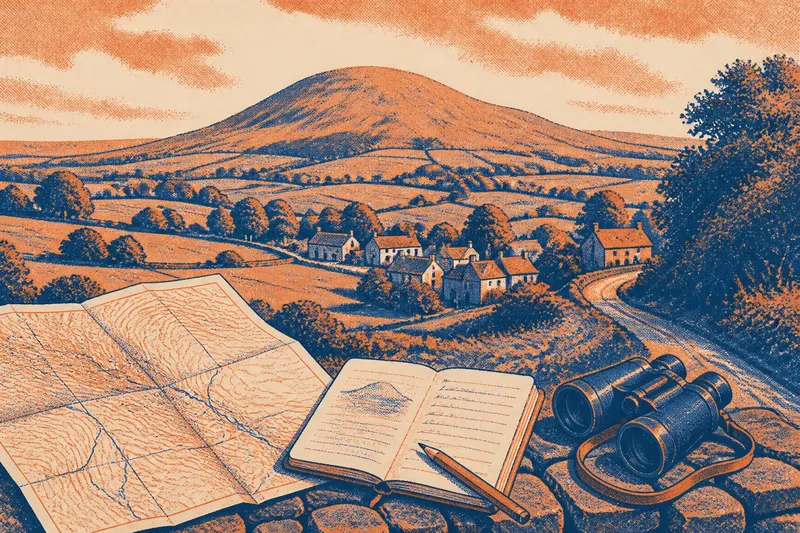
To read a hill in a place name, start with what can still be observed. A rise may shape a settlement’s skyline, mark the edge of a valley, or make a natural point of orientation. The name connects language to terrain, but it does not tell the whole story by itself.
How does a hill become part of a place name?
A hill can lend its name to a summit, a neighborhood, a road, a farm, or an entire settlement. The name may describe the rise directly, distinguish one location from another, or carry a word for a landform from a language used in the region.
Names also travel. A road named for a ridge may pass well below it, and a town name may outlast the feature that first made the site recognizable. As people use a name for new purposes, its connection to the original terrain can become less obvious without disappearing from the record.
What landforms might a hill name describe?
“Hill” is a broad everyday word, not a precise account of shape. In names, related terms may point to a rounded rise, a steep slope, a ridge, a rocky outcrop, or higher ground beside a river or plain. The local meaning can depend on the language and the landscape in which the word was used.
Look at the terrain rather than relying on a modern dictionary alone. A contour map can show whether a named place stands apart or forms part of a longer ridge; an on-site view can reveal how the rise relates to a stream, road, or neighboring settlement. Neither view identifies the name’s original sense, but together they make possible meanings easier to assess.
Can a name reveal who named the hill?
Not on its own. A name that resembles a word in one language might have been borrowed, altered, adapted from an older name, or interpreted later through a familiar word. Spelling can shift as it passes between speakers and maps, so resemblance is a lead to investigate rather than a settled explanation.
The same caution applies to personal names and local stories. A hill named for a person could reflect a genuine association, a later tradition, or a mistaken reading of an older word. To make a stronger case, compare dated maps, local records, language histories, and the physical setting; if those sources do not agree, keep the uncertainty visible.
Which clues help distinguish description from later interpretation?
Several kinds of evidence can help, though each answers a different question:
- Older maps: Compare spellings and note when the name first appears in the material available to you.
- Local records: Check whether deeds, directories, or community documents use the name for the hill itself or for a nearby place.
- Language references: Look for regional forms and possible word changes, rather than matching the name to a single modern word.
- Terrain: Observe the shape, position, and visibility of the rise to see whether a descriptive reading fits the landscape.
- Local usage: Listen for differences between the formal map name and names used in ordinary conversation.
These clues should be compared, not added up as if each were proof of the same claim. A map may establish an earlier spelling, while terrain may support a description; neither necessarily identifies the person who coined it.
What questions should you ask before settling on an origin?
Does the name refer to the hill or the settlement below it?
It may refer to either, or to a larger area that includes both. Check how the name is placed on maps and how it appears in local records before treating it as the hill’s original name.
Does a familiar word prove the name’s meaning?
No. Similar spelling or sound can arise through borrowing, language change, or coincidence. Compare regional word forms and older spellings before choosing an interpretation.
Can a local story establish an origin?
A story can preserve community memory and suggest what to investigate, but it may not identify the earliest meaning. Treat it as one part of the evidence, especially when written forms or the terrain point elsewhere.
What should you do when the evidence conflicts?
Describe the competing readings and say what supports each one. A careful account can identify a likely connection to the landscape while leaving the name’s exact history open.
How can you read one hill name without forcing a story?
Say you come across a place called Round Hill beside a narrow valley. The rise looks rounded from the road, and an older map uses a similar form, but a local record applies the name to the nearby settlement rather than the summit. You could note that the terrain fits a descriptive reading while keeping open whether the name began with the hill or the community beside it.
That restraint is more useful than choosing the neatest explanation. It lets the visible landscape inform the reading without making it stand in for missing evidence.
Which naming details are not worth the effort?
It is usually not worth trying to extract an exact age, original pronunciation, or single naming event from a contemporary sign or map label alone. Those details may be recoverable from records, but the present form cannot supply them by itself.
Nor does every hill name need an elaborate origin story. Sometimes the most honest reading is modest: the name appears connected to a rise in the landscape, while the path by which it acquired that form remains unclear.
When a hill becomes a name, the wording can preserve a practical way of recognizing a place long after its first speakers are gone. Read it alongside the contours, the surrounding names, and the records that survive; the result may be less definitive, but it will be more faithful to the landscape and its layered history.