Footpath or Farm Track: Reading Two Kinds of Route
Read a footpath or farm track through its edges, surface, and connections to make a careful judgment about likely use without relying on width alone.
The common mistake when reading a footpath or farm track is to treat width as a verdict. A broad route with grass down its center and no continuous wheel marks may be little used, while a narrow track beside a hedge can still provide regular farm access. Width is a clue; the surface, edges, and connections show what that clue can support.
Compare the edges across more than one stretch
A footpath may appear as a narrow tread shaped around the passage of people. Its edges can feather into grass, bend around a tussock, or pinch between hedges. A working track may hold a more consistent corridor, with a recognizable lane between field boundaries or a firm strip through open ground.
Neither pattern is decisive on its own. A track can narrow at a gate or where vegetation encroaches, while walkers can wear several parallel lines around a muddy patch. Compare two stretches away from gates, crossings, and junctions, then ask whether the change in width follows a visible obstacle or continues without an obvious cause.
Repeated, bounded width can suggest a route that accommodates recurring movement. An irregular edge or a set of strands that reunite may instead reflect people choosing around local conditions. Describe the pattern you see before assigning it a purpose.
Read the surface as a record of pressure
A thin compacted tread, exposed roots, or a shallow groove can fit regular foot traffic. A firm central strip, coarse aggregate, or paired ruts can fit heavier movement, especially when the marks continue through a bend and appear again beyond a gate.
Look for a sequence rather than one isolated mark. Rain can turn a footpath into a channel, a herd can broaden a narrow passage, and occasional vehicle use may leave little visible evidence. Recent mowing or grading can also smooth the surface and soften the clues.
A change from compacted earth to stone at a wet crossing may show that someone reinforced difficult ground; it does not by itself show who uses the route. Note where the surface changes and whether the same wear pattern continues on either side.
Follow the route to its connections
A narrow line linking a lane with a village green, stream crossing, or boundary gap may serve a direct journey on foot. A broader track approaching field entrances, a yard, or several working plots may connect places where animals, goods, or equipment need to move.
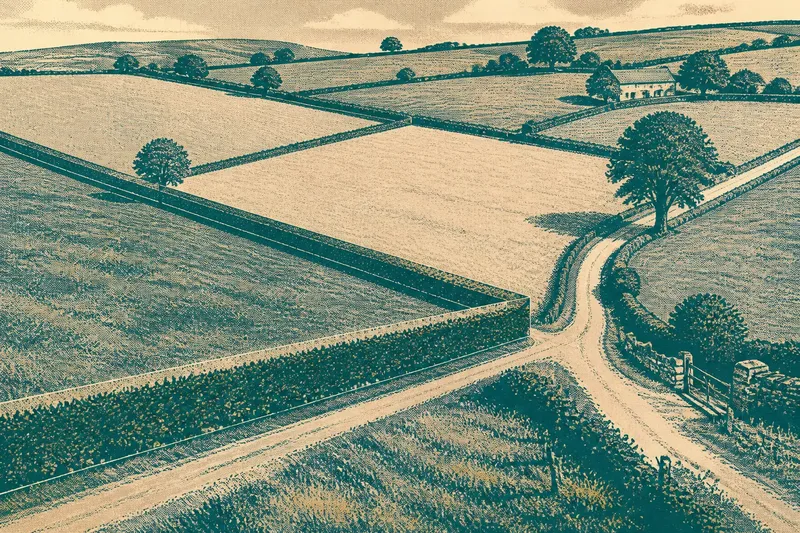
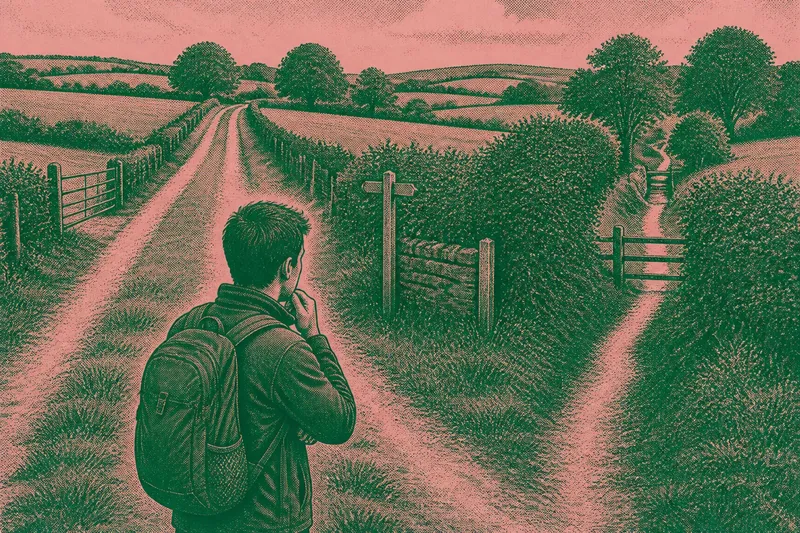
Trace the line in both directions rather than stopping at the nearest building. A hedge opening may be a passage through to a lane beyond, not the route’s destination. At a junction, compare which branch keeps the same tread and which turns toward a gate, bridge, or field entrance.
A footpath and a farm track can share a section before separating. A narrower tread continuing beyond a broad track may indicate a distinct onward route, while the broader surface turns toward a working entrance. Visible wear can suggest this division, but it cannot establish the route’s formal or legal status.
Check each clue and decide what to investigate next
- Width changes at a gate: If the route narrows only at the opening, treat the gate as a likely constraint and compare the stretches on both sides; if it stays narrow, consider whether the whole route is a narrow access line.
- Grass covers the center: If clear paired ruts continue through the grassy section, note possible vehicle passage and check whether the marks resume beyond it; if not, avoid reading the grass alone as proof of disuse.
- Several treads cross soft ground: If they reunite beyond the muddy patch, read them as possible local diversions and follow the clearest continuation; if they remain separate, compare where each connects before treating them as distinct routes.
- A firm strip meets loose ground: If the change occurs at a wet crossing, note possible reinforcement and compare the wear beyond it; if it occurs at a junction, check whether the route itself turns or branches.
- Ruts appear beside a field entrance: If they continue along the route beyond the entrance, consider recurring heavier movement and check for another matching access point; if they stop there, treat them as evidence of access to that entrance only.
- A narrow tread leaves a broad track: If it continues toward a crossing or lane, read the two lines as possibly sharing then separating; if it ends at a nearby opening, inspect the other side before inferring a through-route.
- A route looks overgrown: If a clear tread remains beneath the growth, record the route as physically legible but its current use uncertain; if the line disappears, look for a continuation at the next boundary rather than assuming it ends.
It is not worth trying to infer an exact traffic count from footprints, ruts, or wear. Weather and maintenance alter those marks, and different users can share a route. A more useful question is what kinds of movement the visible evidence can reasonably accommodate.
When does width tell you anything useful?
Does a wide route always mean vehicles use it?
No. Several footpaths, animal movement, or an older track whose use has changed can all leave a broad line. Check for continuing paired ruts, a firm running surface, and access points that make heavier movement plausible.
Can a farm track be narrow?
Yes. Hedges, steep ground, or a gate can constrain a track, and some work routes serve only a small area. Consistent connections to field entrances or a yard may be more informative than width alone.
What does a path that splits into several lines suggest?
It may show people avoiding mud, vegetation, or an obstacle rather than several established routes. Look for a point where the strands reunite and compare their surfaces before treating each as a separate line.
How can you tell whether two routes share a section?
Watch for a change beyond a junction: a narrow tread may continue from a broader track, or the broad surface may turn toward a field entrance while the footpath carries on. A map or local waymark can clarify a formal route, but visible wear alone may not establish legal status.
Work through conflicting clues without forcing a verdict
Say you encounter a broad, grassy route with shallow wheel-like hollows, then a much narrower line leaving it through a hedge gap. First, note that the broad line is wide but overgrown, with hollows that fade before the next field entrance; then trace the narrow tread toward a bridge beyond the hedge. The resulting reading is that the broad line may preserve traces of working access, while the narrow one appears to continue on foot toward a crossing. Because neither line’s current users are visible in those clues, keep that part unresolved.
For a field comparison, choose a stretch away from a gate or junction, compare its edges with a second stretch, and follow any surface pattern through the next opening. At each point, decide whether the clue continues, changes at an obstacle, or fails to connect. If the evidence conflicts, record the strongest reading alongside the uncertainty rather than forcing a category.
Leave room for overlapping use
A footpath and a farm track are not always separate on the ground. They can share a surface, overlap for part of their length, or carry different kinds of movement at different times. A route’s shape can remain after its use shifts, so describe visible marks as evidence that supports a possible reading, not proof of one purpose.
Reading a footpath or farm track carefully means letting the edge, surface, wear pattern, and connections qualify one another. The main phrase, footpath or farm track, is best answered by that combined picture: it can reveal how movement may have shaped a region while leaving uncertain what the route is used for now.